Open Primaries
Our Vision: Open, All-Candidate Primaries
The Problem
-
In most races, the decisive election is the primary, not the general.
-
Millions of voters are locked out because they aren’t registered with a party.
-
Candidates cater to a small sliver of voters—the most partisan—just to win.
The Impact
-
30 million voters couldn’t cast a ballot in primaries that effectively decided elections in 2022.
-
Voters with extreme views are twice as likely to vote in primaries.
-
58% of legislators admit they avoid compromise for fear of losing their primary.
-
Voters face limited choices in November.
-
Partisan activists and special interests hold outsized power.
Our Solution
Open, all-candidate primaries give every voter a ballot that counts.
How It Works
-
Top-Four (or Five) Primary — All candidates run on one ballot, all voters participate. The top four advance to a ranked general election.
-
Top-Two Primary — The top two finishers advance, regardless of party.
-
No Primary — All candidates run in one general election, with a runoff if needed.
Merits of Open Primaries
-
Fairer System — No voter is shut out.
-
Increased Turnout — States with open primaries see higher participation.
-
Better Choices — More candidates compete head-to-head.
-
More Accountability — Politicians must earn majority support, not just partisan loyalty.
Proof of Concept
-
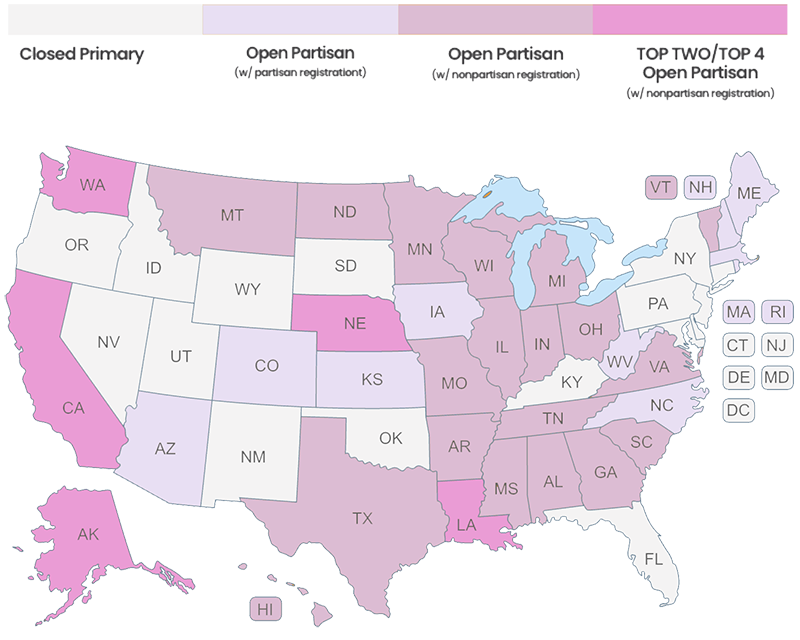
Alaska’s top-four primary debuted in 2022, boosting participation, broadening representation, and rewarding coalition-builders.
-
California and Washington utilize two-two primaries for congressional and state-level elections; Nebraska uses it for state legislative elections.
STATUS OF OPEN PRIMARIES
3 states use open, all-candidate primaries.
31 states allow some form of open primaries (20 fully open, 11 semi-open).
47 states still use partisan primaries.
16 states still use closed primaries.
Here’s the breakdown of primaries for Congressional and State Elections (Presidential primaries may vary):